


Please Leave Us A Message

Haoyong Automotive Controls
In HVAC systems,terms like“actuator”and“motor”are often used interchangeably,leading to confusion among buyers and system designers.While both devices involve motion and electrical power,they serve very different purposes.Understanding the difference between an air conditioner actuator and a motor is essential for proper system design,reliable damper control,and effective airflow regulation.
This distinction becomes especially important in modern HVAC systems where automation,precision,and energy efficiency are critical.
Understanding the Basic Definitions
A motor is a device that converts electrical energy into rotational mechanical energy.Motors are used in countless applications,from fans and pumps to compressors and conveyors.On their own,motors provide motion but do not make decisions or respond directly to control logic.
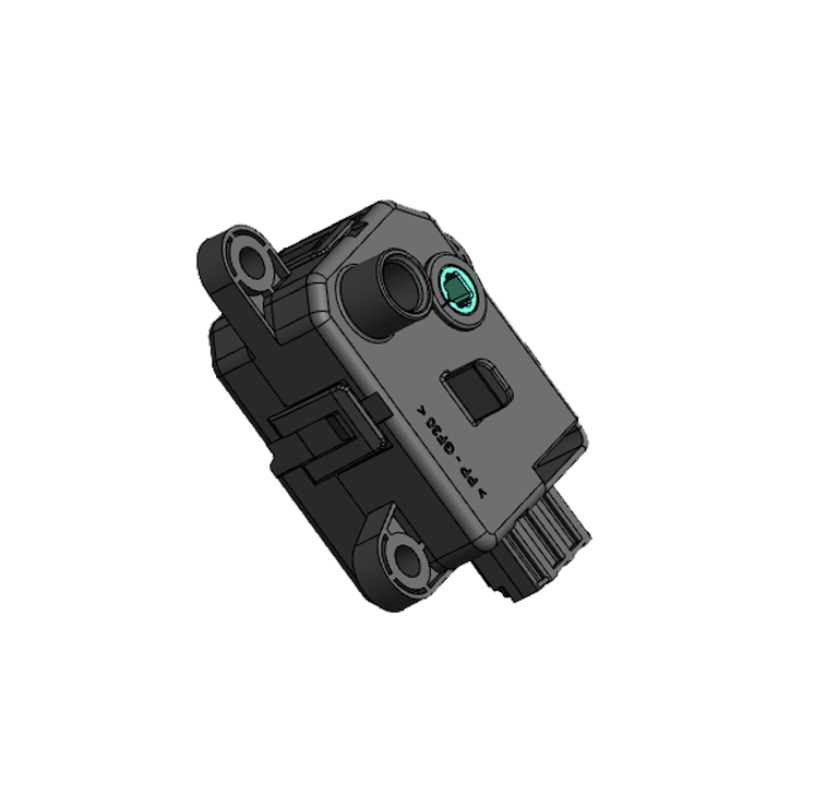
An air conditioner actuator,by contrast,is a complete control device.It includes a motor,but also integrates gearing,control electronics,feedback mechanisms,and a mechanical output designed specifically for damper control or valve operation.In many HVAC applications,the actuator functions as a temperature control actuator rather than just a source of motion.
Function Within an HVAC System
In an HVAC system,motors are commonly used to drive fans,blowers,or compressors.Their role is to generate continuous motion at a defined speed and power level.Once powered,a motor simply runs according to its electrical input.
An air conditioner actuator operates differently.Instead of continuous rotation,it produces controlled,limited movement.It responds to control signals from thermostats or building management systems and positions dampers precisely to regulate airflow.This precise positioning is essential for airflow regulation and zoning control.
Control and Intelligence
A key difference between an actuator and a motor lies in control intelligence.Motors require external controllers,drives,or relays to manage speed,direction,and operation.Without these additional components,a motor cannot perform controlled positioning.
An air conditioner actuator integrates its own control circuitry.It can interpret signals,stop at specific positions,and maintain torque without constant external intervention.This built-in intelligence allows the actuator to perform accurate damper control and function reliably as a temperature control actuator in automated HVAC systems.
Motion Type and Output
Motors typically provide continuous rotational motion.This is ideal for applications such as fans or pumps,where constant movement is required.
Actuators,on the other hand,are designed for controlled movement over a limited range.Depending on the design,an air conditioner actuator may rotate a shaft through a specific angle or move linearly to open or close a damper.This controlled motion is essential for precise airflow regulation rather than simple mechanical movement.
Integration with Dampers and Valves
Motors are general-purpose components and are not specifically designed to mount directly onto HVAC dampers.Additional mechanical assemblies are often required to adapt a motor for damper control,increasing complexity and reducing reliability.
Air conditioner actuators are purpose-built for damper and valve applications.Their output shafts,mounting brackets,and torque characteristics are optimized for HVAC system integration.This direct compatibility simplifies installation and improves long-term performance.
Feedback and Position Holding
Standard motors do not inherently provide position feedback or holding torque when power is removed.Once stopped,they may drift unless additional braking or locking mechanisms are used.
In contrast,many air conditioner actuators include position feedback sensors and gear mechanisms that allow them to hold a damper in place.This capability is critical for maintaining stable airflow regulation and consistent temperature control in an HVAC system.
Energy Efficiency and System Optimization
From an energy efficiency perspective,motors typically consume power whenever they are running.Actuators,however,only draw power during movement or when holding position,depending on the design.
This difference makes actuators particularly suitable for modern HVAC systems focused on energy savings.By adjusting dampers only when necessary,air conditioner actuators contribute to efficient damper control and optimized system performance.
Application-Specific Design
Motors are designed to serve a wide range of industries and applications.While this makes them versatile,it also means they lack HVAC-specific features.
Air conditioner actuators are engineered specifically for HVAC environments.They account for temperature variations,airflow pressure,and control system compatibility.This application-focused design ensures reliable performance as a temperature control actuator across residential,commercial,and industrial HVAC systems.
Why the Difference Matters for Buyers
For HVAC buyers and system integrators,choosing between a motor and an actuator is not a matter of preference but of functionality.Using a motor where an actuator is required can lead to poor airflow regulation,unstable temperature control,and increased system complexity.
An air conditioner actuator provides a complete solution for damper control,combining motion,intelligence,and feedback in a single unit.This integration reduces installation time,simplifies maintenance,and improves system reliability.

Mr. Hansol Kim