


Please Leave Us A Message

Haoyong Automotive Controls
In modern HVAC systems,actuators play a critical role in controlling airflow,temperature balance,and overall energy efficiency.Whether in commercial buildings,industrial facilities,or advanced automation systems,selecting the right HVAC Actuator can directly impact system reliability and safety.One of the most common questions buyers ask during procurement is the difference between spring return and non-spring return HVAC Actuators.
Understanding how these two actuator types work,where they are best applied,and what factors influence the choice can help engineers,contractors,and OEM buyers make better long-term decisions.
A spring return HVAC Actuator is designed with an internal spring mechanism that automatically drives the actuator to a predefined position when power is lost.This fail-safe function is the defining characteristic of spring return designs.When electrical power is supplied,the motor works against the spring force to move the damper or valve to its operating position.Once power is cut,the spring releases and forces the actuator back to its safety position,usually fully open or fully closed depending on system design.
This automatic return behavior makes spring return HVAC Actuators especially valuable in applications where safety,smoke control,or equipment protection is critical.In fire and smoke damper systems,for example,airflow must be stopped immediately during power failure to prevent the spread of smoke.In these scenarios,relying on manual intervention or control signals is not acceptable,and a spring return HVAC Actuator provides a mechanical guarantee of response.
Non-spring return HVAC actuators,on the other hand,do not include a spring mechanism.They rely entirely on the motor and control signal to change and hold position.When power is lost,the actuator remains in its last position rather than moving automatically to a fail-safe state.This design makes non-spring return actuators structurally simpler,lighter,and often more cost-effective.
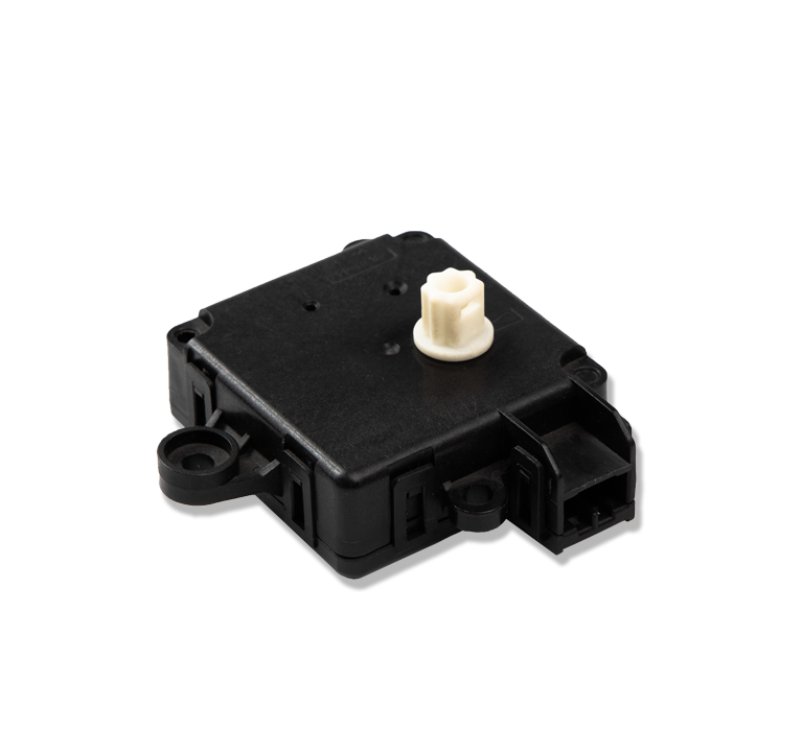
Because of their simplicity,non-spring return HVAC actuators are widely used in comfort ventilation systems where fail-safe positioning is not mandatory.Typical applications include supply air dampers,return air dampers,and zoning systems in commercial buildings where temporary power loss does not pose a safety risk.In these cases,maintaining the last damper position is acceptable,and system logic can resume control once power is restored.
One of the key differences between these two HVAC Actuator types is energy consumption.Spring return actuators generally consume more power during operation because the motor must overcome the spring force every time it moves.Non-spring return actuators only consume energy when actively repositioning,making them more energy-efficient in steady-state operation.Over time,this difference can influence operational costs,particularly in large buildings with hundreds of actuators installed.
Installation and maintenance considerations also differ.Spring return HVAC actuators are usually heavier and slightly more complex due to the spring assembly.This can affect mounting requirements and installation time.However,their mechanical fail-safe function reduces reliance on external backup power systems or additional safety controls.Non-spring return actuators are easier to install and maintain,with fewer internal components that may wear out over time.
Cost is another deciding factor during purchasing.Spring return HVAC actuators typically come at a higher initial price point,reflecting their additional mechanical components and safety functionality.For projects with strict safety regulations or building codes,this cost is often justified and unavoidable.For standard HVAC applications focused on comfort control and efficiency,non-spring return HVAC actuators offer a more economical solution without compromising performance.
From a control perspective,both actuator types are compatible with common HVAC control signals such as on/off,floating,or modulating control.The choice between spring return and non-spring return does not limit integration with building automation systems,but it does influence system behavior during abnormal conditions like power failure or emergency shutdown.
Ultimately,selecting the right HVAC Actuator depends on system requirements rather than preference alone.If safety positioning,emergency response,or regulatory compliance is required,spring return actuators are the clear choice.If the application prioritizes cost efficiency,simplicity,and energy savings,non-spring return actuators provide reliable and widely accepted performance.
By understanding the operational differences and real-world use cases,buyers can ensure their HVAC systems remain safe,efficient,and aligned with project goals throughout the system lifecycle.

Mr. Hansol Kim