
What Is the Difference Between On-Off and Modulating HVAC Actuators?
HVAC Actuators play an important role in controlling airflow, dampers, valves, and other components in heating, ventilation, and air conditioning systems. When selecting an HVAC Actuator, one of the most important decisions is whether an on-off actuator or a modulating actuator is more suitable for the application. Although both types are designed to convert a control signal into mechanical movement, they operate differently and provide different levels of control.
Understanding the difference between on-off and modulating HVAC Actuators can help engineers, system designers, installers, and building operators choose an appropriate solution for their specific HVAC application. The choice affects how accurately a system can control airflow or fluid flow, how the actuator responds to a controller, and how the overall HVAC actuator system operates.
What Is an On-Off HVAC Actuator?
An on-off HVAC actuator is a type of actuator designed to move between two primary positions, typically fully open and fully closed. Instead of continuously adjusting its position, the actuator receives a control command that tells it to move to one of these predefined positions.
For example, when an HVAC controller sends an open signal, the actuator moves the damper or valve toward the open position. When the controller sends a close signal, the actuator moves it toward the closed position. Once the actuator reaches the required position, it stops moving.
This simple operating principle makes on-off actuators suitable for applications where continuous adjustment is not required. They are commonly used for basic ventilation control, isolation dampers, exhaust systems, and applications where airflow only needs to be turned on or off.
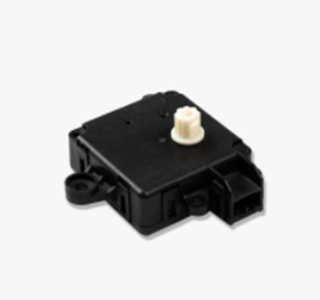
The HVAC actuator mechanism in an on-off actuator is generally straightforward. Depending on the design, the actuator may use an electric motor, gears, limit switches, and other mechanical components to convert the electrical control signal into rotational or linear movement.
What Is a Modulating HVAC Actuator?
A modulating HVAC actuator is designed to provide continuous or incremental positioning rather than simply moving between fully open and fully closed positions. It can adjust the position of a damper or valve according to the control signal it receives.
For example, instead of having only 0% and 100% positions, a modulating actuator may position a damper at 20%, 40%, 60%, 80%, or any other position within its operating range. This allows the HVAC system to make more precise adjustments to airflow or fluid flow.
Modulating HVAC Actuators are commonly used where maintaining a specific temperature, airflow rate, pressure, or other operating condition is important. They can work together with sensors and building control systems to continuously adjust the position of a damper or valve as system conditions change.
In a typical modulating HVAC actuator system, a controller receives information from temperature, pressure, humidity, or airflow sensors. The controller then determines the desired actuator position and sends an appropriate control signal. The actuator responds by moving the connected component to the required position.
How Do On-Off and Modulating HVAC Actuators Work Differently?
The main difference between these two actuator types is how they control position. An on-off actuator generally has two operating states, while a modulating actuator can provide multiple intermediate positions.
Consider an HVAC damper as an example. An on-off actuator can open the damper completely when ventilation is required and close it when ventilation is not required. A modulating actuator, on the other hand, can partially open the damper based on the current ventilation requirement.
This difference directly affects HVAC actuator control. With an on-off actuator, the control system primarily determines whether the actuator should be open or closed. With a modulating actuator, the control system determines how far the actuator should move and can continuously adjust its position as conditions change.
On-Off vs. Modulating HVAC Actuators: Key Differences
| Feature | On-Off HVAC Actuator | Modulating HVAC Actuator |
|---|---|---|
| Position control | Usually fully open or fully closed | Multiple positions within the operating range |
| Control method | Basic switching control | Continuous or proportional control |
| Control precision | Suitable for basic control | Suitable for more precise control |
| Typical signal | On/off command | Proportional control signal |
| Airflow adjustment | Limited to predefined positions | Can continuously adjust airflow |
| System complexity | Generally simpler | Generally more advanced |
| Typical applications | Isolation and basic ventilation control | Temperature, airflow, and pressure regulation |
What Are the Advantages of On-Off HVAC Actuators?
One of the main advantages of an on-off HVAC Actuator is its simple operating principle. Because the actuator only needs to move between defined positions, the control logic can be relatively straightforward. This can make it suitable for HVAC systems where precise proportional adjustment is unnecessary.
On-off actuators can also be appropriate for isolation applications. For example, a damper may need to remain closed under normal conditions and open when a ventilation or air-handling function is activated. In such situations, continuous positioning may provide little additional value.
Another advantage is that on-off control can simplify system design. When the application only requires two operating states, using a modulating actuator may introduce unnecessary control complexity.
What Are the Advantages of Modulating HVAC Actuators?
The main advantage of a modulating HVAC Actuator is its ability to provide more precise positioning. Instead of switching between two states, the actuator can adjust a damper or valve according to the actual requirements of the HVAC system.
This can be particularly useful for maintaining stable indoor conditions. For example, if the temperature in a conditioned space changes gradually, a modulating actuator can adjust the damper or valve incrementally instead of repeatedly switching between fully open and fully closed positions.
Modulating control can also provide better coordination between the actuator and other HVAC components. When integrated with sensors and an automated building control system, the actuator can respond to changing operating conditions and make continuous adjustments.
For larger or more sophisticated HVAC installations, this level of control can be valuable because airflow and other system variables may need to be adjusted according to changing demand.
What Control Signals Are Used With Modulating HVAC Actuators?
Modulating actuators commonly use proportional control signals. Depending on the actuator and control system, these signals may include voltage or current-based signals. Common examples include 0–10 V and 2–10 V control signals.
The principle is relatively simple. A lower control signal corresponds to one actuator position, while a higher signal corresponds to another position. The actuator interprets the signal and moves to the corresponding position within its operating range.
The exact signal requirements depend on the specific actuator and controller. Therefore, when designing an HVAC actuator system, it is important to verify that the actuator's control input is compatible with the output signal provided by the controller.
Are On-Off Actuators or Modulating Actuators Better?
Neither type is universally better. The appropriate choice depends on the requirements of the HVAC application.
An on-off actuator can be a practical choice when the system only requires basic open-and-close operation. For example, an isolation damper that only needs to open when a ventilation system is operating may not require proportional positioning.
A modulating actuator is generally more appropriate when the system needs continuous adjustment. Applications involving variable airflow, temperature regulation, pressure control, or integration with an advanced building automation system may benefit from proportional actuator control.
The important point is to match the actuator's control capability with the requirements of the HVAC system rather than choosing an actuator based only on its general specifications.
How Do You Choose Between an On-Off and Modulating HVAC Actuator?
Several factors should be considered when selecting an HVAC Actuator. First, determine whether the connected damper or valve needs only two positions or requires intermediate positioning. This is usually the most important distinction.
Next, check the control system. The controller must be capable of providing the appropriate type of control signal. An actuator designed for proportional control may not be suitable for a simple on-off control system unless the control architecture supports it.
The required torque or force should also be considered. The actuator needs sufficient output to move the connected damper or valve under actual operating conditions. Other factors may include operating time, rotation angle, power supply, mounting arrangement, environmental conditions, and the required return function.
For larger HVAC installations, system designers should also consider how the actuator will interact with sensors, controllers, and building automation systems. Proper compatibility can help ensure that the entire HVAC actuator control system operates as intended.
Can an On-Off HVAC Actuator Be Replaced With a Modulating Actuator?
In some applications, an on-off actuator can be replaced with a modulating actuator, but the replacement should not be considered a direct upgrade in every situation. The control system, wiring, actuator input signal, mechanical connection, torque requirements, and damper or valve characteristics all need to be checked.
If the existing controller only provides an on-off signal, installing a modulating actuator may not provide the expected proportional control. Additional control equipment or configuration may be necessary.
It is therefore important to evaluate the complete actuator and control system before making a replacement. Mechanical compatibility alone does not guarantee that two actuators are electrically or functionally interchangeable.
Conclusion
The key difference between on-off and modulating HVAC Actuators is the level of position control they provide. An on-off actuator generally moves between defined open and closed positions, making it suitable for applications that require simple switching control. A modulating actuator can move to intermediate positions and continuously adjust a damper or valve according to a control signal.
When selecting an HVAC Actuator, it is important to consider the required control method, actuator torque, power supply, control signal, mechanical connection, and the requirements of the overall HVAC actuator system. Understanding these differences makes it easier to select an actuator that matches the intended application and control strategy.