


Please Leave Us A Message

Haoyong Automotive Controls
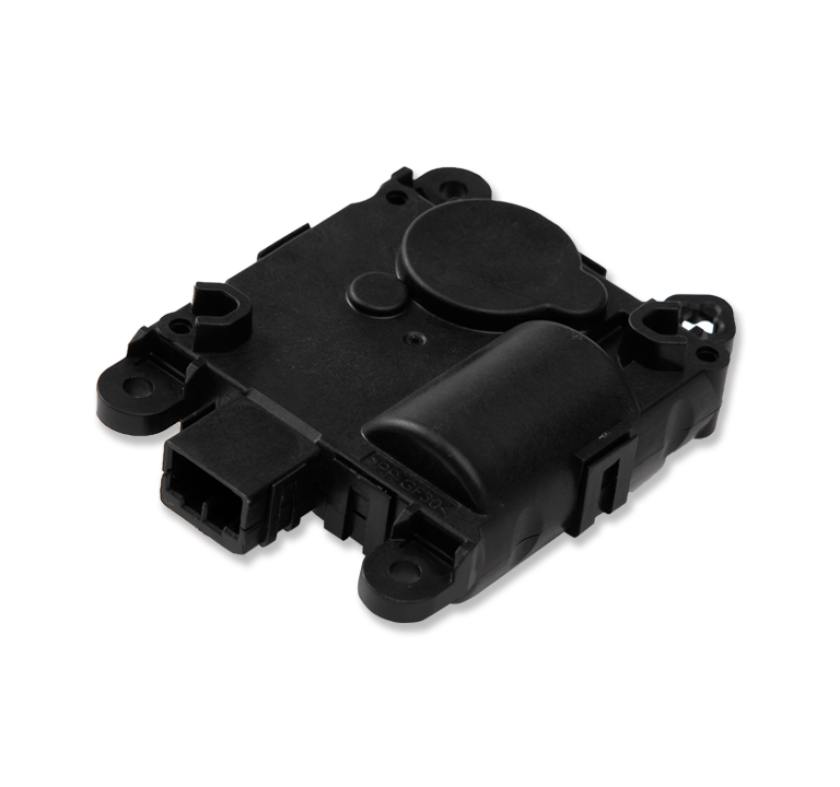
A Car Air Conditioner Actuator is an electromechanical component used to control airflow and temperature inside a vehicle's HVAC system. It converts electrical signals from the climate control system into mechanical movement, allowing air-conditioning doors to move to the required position.
Although an actuator is relatively small, it plays an important role in regulating cabin comfort. Depending on the HVAC design, different actuators can control temperature, airflow direction, fresh-air intake, and air recirculation.
The working principle of an actuator is relatively simple. When the driver changes the temperature or airflow setting, the HVAC control module sends an electrical signal to the actuator.
The actuator contains a small electric motor, a reduction gear mechanism, an output shaft, and, in many designs, a position sensor. The motor rotates at high speed, while the gear system reduces the speed and increases the available torque. This controlled movement is transferred to an HVAC door.
For example, when the driver selects a higher temperature, the temperature blend Door Actuator changes the position of the blend door. This adjusts the ratio of heated and cooled air entering the cabin.
Other common actuator types include:
Mode door actuator – directs air toward the face, feet, or windshield.
Recirculation door actuator – switches between outside air and recirculated air.
Blend door actuator – regulates the mixture of hot and cold air.
In automatic climate control systems, a position sensor can provide feedback to the control module. This allows the actuator to move the HVAC door accurately to the required position.
The production of an automotive HVAC actuator involves both precision mechanical manufacturing and electronic assembly.
The actuator housing and internal gears are commonly produced through plastic injection molding. The mold needs to maintain accurate dimensions because gear alignment and housing tolerances directly affect actuator performance.
After molding, the electric motor, gears, output shaft, sensor, circuit board, and electrical connector are assembled.
The reduction gear system is particularly important. Its gear ratio determines the relationship between motor speed and output torque. Proper gear engagement can reduce friction, operating noise, and premature wear.
After assembly, manufacturers normally perform functional tests. These may include rotation angle, output torque, current consumption, operating noise, position accuracy, and endurance testing.
For an automotive HVAC actuator manufacturer, consistent dimensional control and reliable assembly are important for maintaining stable performance across large production volumes.
Material selection has a direct impact on actuator durability and performance.
Engineering plastics are widely used for actuator housings and gears. POM (polyoxymethylene) is commonly considered for gears because of its low friction, wear resistance, and dimensional stability. PA (polyamide) and reinforced nylon can be used for structural components where higher strength and temperature resistance are required.
Metal materials are also used in selected components. Steel can be used for shafts and other load-bearing parts, while copper or copper alloys are commonly used for electrical terminals.
The material must be suitable for the automotive environment, where components may experience vibration, temperature fluctuations, humidity, and repeated operating cycles.
Electronic actuators offer several advantages compared with traditional mechanical control systems.
First, they provide accurate position control. The HVAC control module can adjust the actuator according to temperature and airflow requirements.
Second, their compact structure makes them suitable for modern vehicle HVAC systems where installation space is limited.
Third, actuators can easily integrate with electronic climate control systems. This makes features such as dual-zone and automatic temperature control possible.
Other advantages include low power consumption, flexible control, compact size, and compatibility with intelligent vehicle systems.
Despite their advantages, actuators can experience mechanical or electrical failures.
Gear wear is one common problem. After repeated operation, plastic gear teeth may become worn or damaged, causing abnormal noise or inaccurate door positioning.
Motor failure can prevent the actuator from moving, while a faulty position sensor may cause the control system to receive incorrect feedback.
Other potential problems include damaged connectors, worn output shafts, excessive friction, and housing deformation.
Because the actuator operates repeatedly throughout the vehicle's service life, durability and cycle testing are important parts of actuator development.
Actuators are widely used in passenger cars, SUVs, commercial vehicles, electric vehicles, and other vehicles equipped with electronically controlled HVAC systems.
In conventional vehicles, they mainly control temperature mixing, airflow direction, and air recirculation.
In electric vehicles, precise HVAC control is becoming even more important because heating and cooling can affect energy consumption and driving range. As a result, modern automotive air conditioning actuator designs increasingly focus on compact structures, low power consumption, low noise, and precise positioning.
Actuators can also work together with temperature sensors, humidity sensors, sunlight sensors, and HVAC control modules to create automatic climate control systems.
A car air conditioner actuator is a key component that connects electronic climate control with mechanical airflow adjustment. By using a motor, reduction gears, sensors, and an output mechanism, it can accurately control HVAC doors and regulate cabin temperature and airflow.
From injection-molded housings and precision gears to motor assembly and functional testing, every stage of production can influence actuator performance.
As vehicle HVAC systems become more intelligent and electronically controlled, reliable actuator technology will continue to be an important part of automotive climate control systems.

Mr. Hansol Kim