


Please Leave Us A Message

Haoyong Automotive Controls
When people ask, “How many AC actuators are in a car?”, the answer is not always a single fixed number. Most modern vehicles use several actuators as part of the heating, ventilation, and air conditioning system, commonly known as the HVAC system. Depending on the vehicle model, climate control configuration, number of temperature zones, and overall HVAC design, a car may use approximately 3 to 8 actuators, while some advanced systems can use even more.
These small electromechanical components play an important role in controlling airflow direction, temperature, fresh air intake, and air circulation. Although an actuator may not be as visible as the compressor, condenser, or evaporator, it directly affects how effectively the vehicle's air conditioning system responds to driver and passenger settings.
An AC actuator is an electromechanical device used to move or adjust components inside a vehicle's HVAC system. It typically converts an electrical control signal into mechanical movement. The actuator can open, close, or position an HVAC door according to instructions received from the vehicle's climate control module.
In automotive applications, an actuator is commonly connected to components such as a blend door, mode door, or recirculation door. These doors control where air flows and how warm or cool the air becomes before entering the passenger compartment.
For example, a blend Door Actuator can regulate the proportion of air passing through the heater core and the cooling side of the HVAC housing. By changing the position of the door, the system can provide warmer or cooler air without directly changing the operation of the air conditioning compressor.
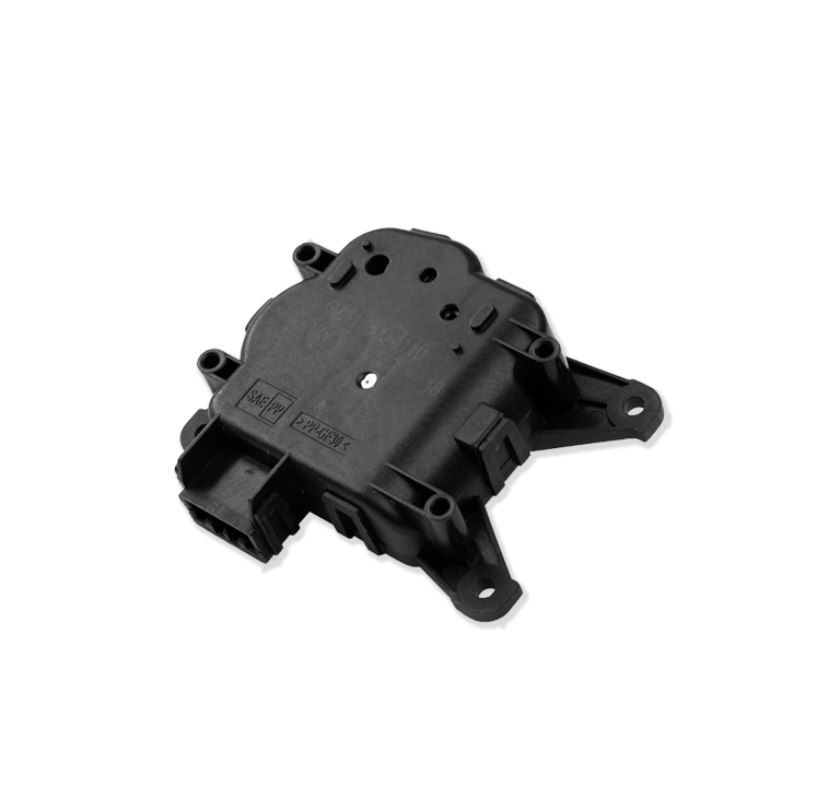
The number of actuators depends heavily on the HVAC architecture of the vehicle. A basic vehicle with manual air conditioning may use only a few actuators, while a vehicle equipped with automatic dual-zone or multi-zone climate control can require several additional units.
A typical HVAC system may include the following actuator functions:
Blend Door Actuator for temperature adjustment
Mode door actuator for directing airflow
Recirculation door actuator for switching between fresh and recirculated air
Left and right temperature actuators in dual-zone systems
Additional zone actuators in multi-zone climate control systems
Therefore, a vehicle with single-zone climate control may have around 3 to 4 actuators, whereas a dual-zone or more sophisticated HVAC system may use 5 to 8 or more. The exact quantity should always be determined from the vehicle's HVAC design and service documentation.
The working principle of an automotive AC actuator is relatively straightforward but requires precise positioning. The actuator receives an electrical signal from the HVAC control module or climate control system. According to the requested temperature or airflow mode, an internal electric motor rotates in a specific direction.
The motor's rotational movement is transferred through a reduction gear mechanism. The gears increase the actuator's output torque while reducing rotational speed, allowing the actuator to move an HVAC door accurately.
Many modern actuators also include a position feedback system. A potentiometer, Hall-effect sensor, or other position-sensing component can detect the current position of the output shaft. The control module can then compare the actual position with the target position and make adjustments when necessary.
The basic operating sequence can be described as:
The driver selects a temperature or airflow setting.
The HVAC control module calculates the required door position.
An electrical signal is sent to the actuator.
The internal motor rotates.
The gear train transfers and reduces the motor's speed.
The output shaft moves the HVAC door.
The position sensor provides feedback to the control module.
The actuator stops when the required position is reached.
This closed-loop control process allows the HVAC system to maintain more consistent temperature and airflow conditions inside the vehicle.
Different HVAC functions require different types of actuators. The most common design is the electric gear actuator, but the internal structure can vary according to the vehicle manufacturer and application requirements.
The blend door actuator controls the temperature of air entering the cabin. It changes the position of the blend door to regulate the amount of air passing through the heater core. A malfunctioning blend door actuator can result in incorrect temperature output, such as cold air when heat is selected or warm air when cooling is required.
The mode actuator determines where conditioned air is delivered. It can direct air toward the dashboard vents, floor vents, windshield defroster outlets, or a combination of these locations. Accurate positioning is important because even a small movement error can affect airflow distribution.
The recirculation actuator controls whether the HVAC system draws air from outside the vehicle or recirculates air already inside the cabin. Recirculation is often used to cool the cabin more efficiently or reduce the entry of outside odors and pollutants.
The materials used in an AC actuator must withstand vibration, temperature changes, repeated movement, and long operating cycles. Since the actuator is installed inside or close to the HVAC housing, material selection directly influences durability, dimensional stability, noise, and manufacturing cost.
Engineering plastics are widely used for the actuator housing and internal gears. Materials such as POM, PA, and reinforced engineering polymers can provide a combination of dimensional stability, wear resistance, low friction, and relatively low weight.
The housing is commonly produced using injection molding. Plastic housings are lightweight and can be manufactured with complex structures, mounting points, electrical connector interfaces, and gear support features in a single component.
Internal gears may also be manufactured from engineering plastics. For higher-load applications, different grades of reinforced polymer or metal components may be selected depending on torque requirements and expected service life.
The motor normally contains copper windings, permanent magnets, a rotor, and other electrical components. Metal shafts and precision components are selected where higher mechanical strength and dimensional accuracy are required.
The manufacturing process for an automotive AC actuator normally involves several stages, from plastic injection molding and gear production to motor assembly, electronic integration, testing, and final inspection.
1. Injection Molding
The actuator housing and some internal plastic components are produced through precision injection molding. Mold design, material drying, injection temperature, pressure, cooling time, and dimensional control can all affect the final component quality.
2. Gear Manufacturing
Plastic gears must maintain accurate tooth profiles and dimensional tolerances because gear accuracy affects torque transmission, operating noise, and service life. Proper material selection and molding parameters are particularly important for small automotive gears.
3. Motor Assembly
The electric motor is assembled with the required rotor, stator, winding, shaft, and related components. The motor must provide sufficient torque while maintaining suitable electrical and mechanical performance.
4. Gear Train Assembly
The motor is connected to a reduction gear system. The gear train converts high-speed motor rotation into controlled output movement. Lubrication may be applied to reduce friction and wear during repeated operation.
5. Position Sensor Integration
A position sensor can be installed to monitor the output shaft. Depending on the actuator design, this may involve a potentiometer, Hall sensor, or another feedback mechanism.
6. Final Assembly and Testing
After assembly, the actuator is tested for electrical performance, output movement, torque, operating noise, current consumption, position accuracy, and endurance. Automotive manufacturers may also require temperature cycling, vibration, humidity, and repeated operating tests.
One major advantage of an automotive AC actuator is its precise control. Compared with simple mechanical control mechanisms, an electronic actuator can receive commands directly from an automatic climate control system and adjust the HVAC door to a specific position.
Another advantage is compactness. A small motor and gear mechanism can provide sufficient torque to operate an HVAC door while occupying relatively limited installation space.
AC actuators also support advanced climate control functions. Multiple actuators can work independently to create separate temperature zones for the driver, front passenger, and rear passengers.
In addition, electronic control allows actuators to communicate with vehicle control systems, making them suitable for modern vehicles with automatic HVAC, digital temperature displays, and integrated vehicle electronics.
Despite their advantages, AC actuators can experience mechanical and electrical failures. Because the actuator operates repeatedly throughout the vehicle's service life, the internal gears may eventually wear, especially if the component is exposed to excessive resistance or repeated mechanical loading.
Another common issue is position sensor failure. If the control module receives an incorrect feedback signal, the actuator may stop at the wrong position or repeatedly move back and forth while attempting to find the target position.
Electrical problems can also affect actuator operation. Damaged wiring, connector problems, motor failure, or control module faults may prevent the actuator from responding correctly.
Typical symptoms of a faulty actuator include clicking or knocking noises behind the dashboard, incorrect temperature control, weak airflow from selected vents, air coming from the wrong outlet, or failure of the recirculation function.
AC actuators are primarily used in automotive HVAC systems, but their applications extend beyond passenger cars. They can be found in SUVs, trucks, buses, electric vehicles, and other vehicles equipped with electronically controlled climate systems.
In electric vehicles, HVAC Actuator technology is particularly important because thermal management and energy efficiency are closely connected to overall vehicle performance. Precise control of airflow and temperature can help the vehicle manage cabin comfort while controlling energy consumption.
Automotive suppliers also develop different actuator configurations for manual HVAC systems, automatic climate control, dual-zone systems, rear climate control, and multi-zone systems.
Although an AC actuator is relatively small, its performance can directly affect the user experience of the entire HVAC system. An actuator with poor gear accuracy may generate excessive operating noise, while insufficient torque can cause incomplete door movement.
For manufacturers and automotive suppliers, important quality factors include dimensional accuracy, gear engagement, motor performance, sensor accuracy, torque output, operating noise, temperature resistance, vibration resistance, and long-term durability.
Manufacturing consistency is equally important. Stable injection molding processes, accurate gear production, controlled assembly tolerances, and automated functional testing can help reduce variation between individual actuators.
So, how many AC actuators are in a car? There is no universal number. A basic HVAC system may use approximately 3 to 4 actuators, while dual-zone, multi-zone, and advanced automatic climate control systems can require 5 to 8 or more actuators.
Each actuator performs a specific function, such as controlling temperature, airflow direction, or fresh-air and recirculation modes. Behind these compact components is a combination of electric motors, reduction gears, position sensors, engineering plastics, metal components, and precision manufacturing processes.
As automotive HVAC systems become increasingly electronic and intelligent, reliable actuator design will continue to be important. For manufacturers, selecting suitable materials, optimizing injection molding and gear manufacturing processes, and implementing comprehensive performance testing are key factors in producing durable and precise HVAC Actuator components.
A dual-zone HVAC system commonly uses several actuators, often around 5 or more depending on the system design. Separate temperature control for the driver and passenger sides may require additional blend door actuators.
A failed actuator can cause incorrect temperature, improper airflow direction, unusual clicking noises, or failure of the recirculation function. The exact symptoms depend on which actuator has failed.
No. Actuator design varies by vehicle manufacturer, HVAC architecture, installation space, torque requirement, control strategy, and climate control configuration. Different vehicles can therefore use actuators with different dimensions, gear structures, motors, sensors, and connectors.
Engineering plastics such as POM and PA are commonly considered for actuator gears because they offer low friction, good wear resistance, dimensional stability, and relatively low weight. The exact material depends on the load, temperature, noise, and durability requirements of the application.

Mr. Hansol Kim