
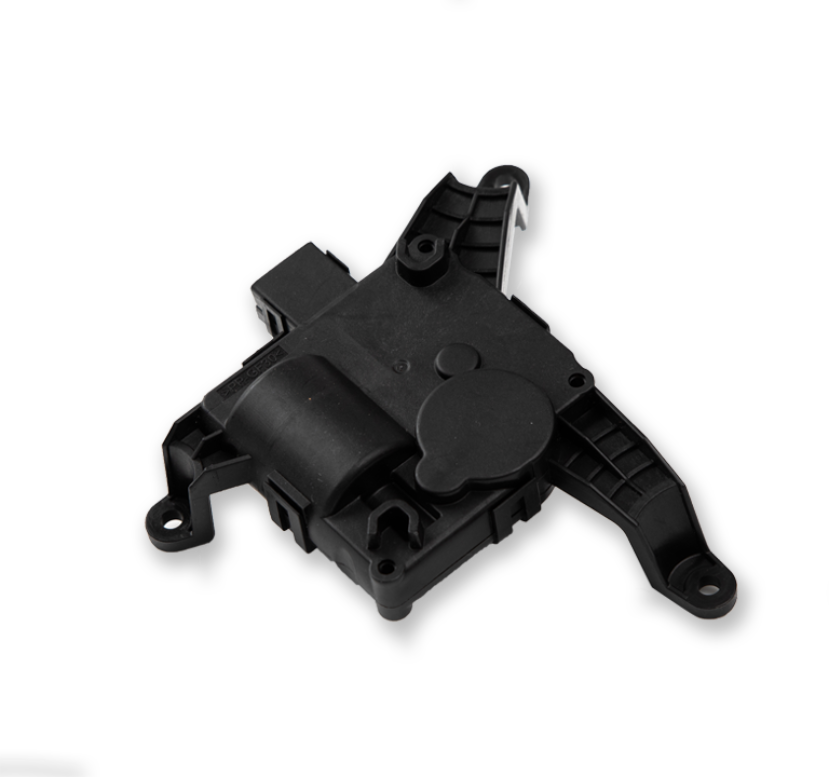
An AC actuator in a car is an electromechanical device that moves the air doors inside the vehicle's heating, ventilation, and air conditioning (HVAC) system. It controls how air flows through different passages, allowing the climate control system to regulate cabin temperature, select air outlets, and switch between outside air and recirculated air. The performance of an AC actuator depends on more than its electric motor. Gear accuracy, housing dimensions, output torque, position feedback, and assembly consistency all determine whether the actuator can operate reliably over thousands of movement cycles.
For automotive parts importers, wholesalers, distributors, and replacement-part suppliers, understanding these factors is essential when evaluating product quality. This guide explains how an AC actuator works, how manufacturers produce its critical components, why specific manufacturing defects occur, and which inspection procedures help verify performance before bulk orders are approved.
1. What Does an AC Actuator Do in a Car?
An AC actuator converts an electrical command from the vehicle's HVAC control system into mechanical movement. Depending on the design, it rotates or moves an output shaft connected to an air door. The door then changes the direction, temperature, or source of the airflow entering the passenger compartment.
Three common applications illustrate the differences between actuator functions.
Blend Door Actuator: Adjusts the proportion of air passing through different temperature-control paths, helping the HVAC system deliver the requested cabin temperature.
Mode door actuator: Operates the air distribution door to direct airflow toward dashboard vents, floor outlets, or windshield defroster outlets.
Recirculation door actuator: Controls the intake door that selects outside air or recirculated cabin air.
These applications are related but not interchangeable in every vehicle. A particular air door actuator may have a different operating angle, output coupling, mounting arrangement, electrical connector, or control strategy depending on its intended application.
The distinction matters because the actuator must move the door to the correct position, not simply turn its motor. If the actuator stops too early, the door may restrict airflow or produce inconsistent temperature control. If the mechanism encounters excessive resistance, the motor may draw more current, the gears may wear prematurely, or the actuator may fail to complete its travel.
2. How an AC Actuator Converts Electrical Signals into Movement
Most conventional automotive HVAC Actuators use a compact electric motor connected to a reduction gear train. When the climate control system requests a new door position, the actuator receives an electrical command and moves its output shaft. Depending on the design, position feedback helps the control system determine whether the requested position has been reached.
The reduction gear train is essential because a small motor can rotate rapidly without generating sufficient torque to move an air door directly. Multiple gear stages reduce output speed while increasing usable torque. The gear ratio must balance movement speed, available torque, positioning requirements, packaging limitations, and operating noise.
Position control introduces another engineering challenge. Some designs use a potentiometer to translate shaft movement into a changing electrical signal, while others use contactless magnetic sensing. The control arrangement varies by actuator architecture, so buyers should not assume that all HVAC Actuator car products use the same feedback system.
For example, if the output shaft moves but the position sensor reports an incorrect angle, the climate control module may interpret the door position incorrectly. Conversely, a correctly calibrated sensor cannot compensate for a stripped gear or a mechanically obstructed door. Reliable operation therefore requires coordinated performance across the electrical, mechanical, and feedback systems.
3. Material Selection and Its Impact on Manufacturing Quality
Material selection establishes the foundation for actuator durability. The housing must maintain the alignment of internal components, the gears must transmit torque without excessive wear, and the output shaft must withstand the forces applied by the HVAC door. Materials must also remain suitable for the temperature and environmental conditions of the intended installation.
Engineering plastics are commonly used for housings and gear components because they offer low weight, design flexibility, and economical high-volume production. However, different polymers have different stiffness, dimensional stability, wear resistance, moisture sensitivity, and thermal expansion characteristics. A material suitable for a lightly loaded housing may not be appropriate for a highly stressed gear.
Metal shafts and selected metal components may be used where the design requires greater stiffness, wear resistance, or strength. Motor magnets, windings, bearings, electronic components, and electrical contacts must also meet their respective functional requirements.
The key manufacturing decision is not simply choosing the strongest material. It is matching material properties to the actual load, temperature range, geometry, cost target, and expected service life. For example, a gear material with inadequate wear resistance may develop increasing backlash, while a housing with poor dimensional stability may shift the relative positions of gear shafts as temperatures change.
Incoming material control should verify supplier specifications, batch identification, relevant material properties, and critical component dimensions. For plastic parts, material grade and processing history can influence final performance. Maintaining traceability allows manufacturers to investigate whether a recurring defect originates from a material batch, a molding process, or a later assembly operation.
4. Injection Molding: Why Housing Precision Affects Gear Performance
Injection molding is widely used to produce plastic actuator housings and many plastic gears. The process involves heating plastic resin, injecting the molten material into a mold, allowing it to cool, and removing the molded part. Although the process is highly suitable for mass production, achieving consistent dimensions requires control over both tooling and processing conditions.
Important variables include melt temperature, mold temperature, injection pressure, packing conditions, cooling time, and material moisture where relevant. If these conditions are unstable, molded parts may develop shrinkage variation, warpage, sink marks, short shots, or inconsistent dimensions.
These defects can have direct mechanical consequences. Consider a housing containing several gear shafts. If the mounting supports are displaced by molding distortion, the distance between mating gear axes may change. An excessively large center distance can increase backlash and reduce positioning consistency. An excessively small center distance can increase friction, raise motor current, and accelerate wear.
This relationship explains why visual inspection alone is insufficient. A housing may appear acceptable externally while an internal reference surface falls outside its dimensional tolerance. Manufacturers should identify critical-to-function dimensions from the engineering drawing and monitor them using appropriate gauges, dimensional measurement equipment, or coordinate measuring systems.
Tooling design also affects repeatability. Gate location, cooling channel arrangement, cavity balance, and mold wear can influence shrinkage and dimensional consistency. A capable supplier should therefore control both the molding process and the condition of the production mold rather than relying solely on final inspection to remove defective parts.
5. Gear Manufacturing and Assembly: Controlling Torque, Backlash, and Noise
The gear train is one of the most important mechanical assemblies inside an AC actuator. Its purpose is to deliver the torque needed to move the HVAC door while maintaining acceptable speed, positioning accuracy, and operating noise.
Plastic gears are often produced through injection molding, while shafts and other components may be machined, formed, or manufactured using processes suited to their design. Critical characteristics include tooth geometry, pitch accuracy, shaft alignment, material consistency, and the fit between mating gears.
Gear backlash is the clearance between mating gear teeth. Some clearance is necessary for smooth operation, but excessive backlash allows the output shaft to move without an equivalent movement of the motor. This can reduce positioning accuracy and contribute to clicking sounds when the direction of movement changes.
Insufficient clearance creates a different problem. If gear teeth engage too tightly, friction increases and the motor must work harder to move the mechanism. The resulting current increase and heat generation can accelerate material wear or cause the actuator to struggle under load.
Assembly accuracy is equally important. Gears must be installed in the correct sequence and orientation, shafts must seat properly, and the housing must maintain the designed alignment. Where lubrication is specified, its type and application quantity must be controlled. Too little lubricant can increase friction and wear, while an unsuitable lubricant may affect material compatibility or change operating behavior.
Manufacturers should verify smooth transmission, output movement, and abnormal noise during assembly or functional testing. When a noise defect occurs, the investigation should consider gear geometry, shaft fit, housing resonance, lubrication, and the load imposed by the connected door. Replacing the motor alone may not correct a problem originating in the transmission.
6. Motor Assembly, Position Feedback, and Electronic Integration
The motor must provide sufficient torque and speed under the actual operating conditions. Depending on its construction, motor production may involve winding preparation, magnet installation, rotor and shaft assembly, bearing installation, and electrical connection. Variation in these operations can affect starting performance, current consumption, rotational stability, and noise.
Winding resistance, magnet placement, shaft alignment, and bearing friction are particularly relevant to consistency. A motor that performs well without a load may still struggle when connected to a high-resistance door mechanism. Manufacturers should therefore evaluate motor performance against defined electrical and mechanical specifications rather than treating free rotation as proof of adequate output.
During final assembly, the motor, reduction gears, position sensor, circuit board where applicable, and output shaft are integrated into the housing. Sensor installation and calibration are critical because the feedback signal must correspond to the actual output position.
For example, an incorrectly indexed output shaft may cause the sensor to report a position that does not match the physical door angle. An electrical connection defect may produce intermittent feedback, while excessive mechanical friction may prevent the actuator from reaching its commanded endpoint.
Quality controls should therefore verify connector integrity, correct component orientation, sensor response, movement direction, and position consistency. Assembly fixtures and controlled fastening procedures help prevent misalignment, damaged connectors, housing deformation, and wiring interference.
7. Critical Quality Tests for Automotive AC Actuators
A reliable inspection plan connects each test to a specific failure risk. No single test can demonstrate that an actuator is suitable for every operating condition, so manufacturers should combine dimensional, electrical, mechanical, and durability verification.
Dimensional inspection: Critical housing dimensions, mounting holes, shaft interfaces, and gear-related reference features should be checked against approved drawings. This verifies fitment and helps identify process variation before the components enter final assembly.
Electrical testing: Operating voltage, current consumption, electrical continuity, and motor response should be measured under defined conditions. Elevated current may indicate excessive friction, misalignment, or an electrical problem. Results must be interpreted alongside the applied load, temperature, and supply voltage.
Travel and position testing: The actuator should move through its specified operating range, with movement direction, travel time, endpoint behavior, and position feedback verified where applicable. This test can reveal incorrect assembly, sensor calibration errors, gear interference, and incomplete movement.
Output torque testing: Output capability should be compared with the relevant product specification. Testing under a representative load provides more useful information than unloaded rotation alone because it reveals whether the actuator can overcome the resistance of the intended mechanism.
Noise and endurance testing: Operating noise should be evaluated under defined conditions. Endurance cycling can reveal gear wear, increasing backlash, motor deterioration, and changes in positioning performance. Comparing current consumption, noise, output movement, and other relevant measurements before and after cycling helps identify gradual degradation.
Environmental validation: Depending on the vehicle application and customer requirements, testing may include temperature cycling, vibration, humidity exposure, and other environmental stresses. These tests help assess whether materials, lubrication, electrical connections, and mechanical fits remain stable under the intended operating conditions.
Acceptance limits should come from approved drawings, engineering specifications, customer requirements, or applicable validation standards. Manufacturers should not apply arbitrary universal torque, temperature, or cycle-count thresholds to actuators with different designs and operating requirements.
8. Common AC Actuator Failures and How to Trace Their Causes
Failure analysis becomes more effective when the observed symptom is connected to a testable manufacturing hypothesis rather than an assumed cause.
Repeated clicking or knocking: Potential causes include damaged gear teeth, excessive backlash, incorrect assembly, or a door that cannot reach its target position. Inspection should cover the gear train and the external door mechanism before the motor is identified as defective.
Incorrect airflow direction: A mode door actuator or Vent Door Actuator may have incorrect output indexing, inaccurate position feedback, or a mechanically obstructed door. Comparing commanded movement with actual shaft movement can help distinguish electrical feedback errors from mechanical faults.
Inconsistent temperature control: A blend door actuator may fail to position the door correctly because of insufficient output torque, excessive friction, gear damage, or sensor errors. Functional testing under representative load is useful for isolating these causes.
Intermittent operation: Possible causes include unstable electrical connections, motor defects, excessive friction, or electronic faults. Repeated testing under controlled electrical and mechanical conditions can help reproduce the problem and determine whether it is related to temperature, vibration, or load.
For manufacturers, recording failure symptoms, test conditions, component batches, and corrective actions helps identify recurring patterns. This supports process improvement and reduces the likelihood of the same defect appearing in later production batches.
9. How B2B Buyers Can Evaluate an AC Actuator Supplier
For importers, wholesalers, and automotive parts distributors, supplier evaluation should begin with application compatibility and continue through manufacturing capability and quality assurance.
First, verify the operating voltage, connector configuration, mounting dimensions, output shaft design, travel range, and intended HVAC function. Confirm the relevant vehicle application and any required control or position-feedback characteristics. Similar external shapes do not necessarily establish electrical or mechanical interchangeability.
Second, request technical drawings, product specifications, dimensional inspection records, electrical test results, and relevant durability validation reports. Ask how the supplier controls molding variation, gear quality, motor consistency, sensor calibration, and final assembly. For customized products, confirm tooling responsibilities, engineering-change approval, and whether a design or material change requires renewed validation.
Third, establish clear approval requirements before mass production. These may include sample approval, functional acceptance criteria, packaging and labeling specifications, batch traceability, and procedures for handling nonconforming products. If a supplier proposes replacing a motor, gear material, sensor, or other critical component, the change should be evaluated against the approved product specification.
Finally, assess the supplier's ability to maintain consistent quality across repeated orders. Appropriate automotive quality management certification, documented inspection procedures, controlled production records, and a clear corrective-action process can provide useful evidence. Buyers should verify the certification scope and confirm that it covers the relevant manufacturing facility and activities.
Conclusion
An AC actuator in a car is a precision electromechanical component whose performance depends on the combined quality of its motor, reduction gears, housing, output shaft, and position-feedback system. Manufacturing defects rarely remain isolated: a small dimensional deviation can change gear engagement, increase motor load, affect positioning accuracy, and ultimately reduce product reliability.
For automotive parts buyers, understanding these relationships provides a stronger basis for supplier evaluation than comparing appearance or unit price alone. By reviewing manufacturing controls, verifying application compatibility, examining functional and durability test evidence, and establishing clear production approval requirements, buyers can make more informed sourcing decisions and reduce the risk of inconsistent bulk orders.